


Photo by Nahel Abdul Hadi on Unsplash
There’s a strange myth around cybersecurity careers — that you need a CS degree from MIT, a basement full of glowing monitors, and a hoodie collection. You don’t. If you’re trying to figure out how to become a cybersecurity expert, the honest answer is that the path is more open than most career advice admits. It’s also more interesting, better paid, and more in demand than almost any other corner of tech right now.
This is your no-fluff guide to breaking into the field — what the work actually looks like, which roles to aim for, what to study, and how to land your first job even if you’re switching careers from somewhere completely unrelated.
What does a cybersecurity expert actually do?
Strip away the Hollywood version, and the day-to-day is less dramatic than the recruiter ads suggest. Cybersecurity professionals protect the digital plumbing that businesses, hospitals, banks, and governments run on. Some of them write the rules. Others enforce them. A few try to break them on purpose so the bad guys can’t.
A typical week might include patching a server before someone exploits it, hunting through log files for suspicious behaviour, writing a policy that explains why finance can’t share passwords over Slack, or sitting on a video call explaining to a CEO why the board needs to care about a vulnerability in a vendor’s software. It’s part detective work, part engineering, part diplomacy.
Why this is one of the best careers to break into right now
The numbers tell a story most career fields would kill for. According to the (ISC)² 2024 Cybersecurity Workforce Study, roughly 4.8 million people are working in cybersecurity globally — and the industry still needs millions more to fill open roles. In the United States alone, the U.S. Bureau of Labour Statistics projects employment of information security analysts to grow by about 33% between 2023 and 2033, which is roughly eight times faster than the average for all occupations.
Why? Because attacks aren’t slowing down. IBM’s 2024 Cost of a Data Breach Report put the global average cost of a single breach at $4.88 million — a record high. Every time a hospital gets hit with ransomware or a retailer loses customer card data, somebody on the inside has to clean it up. That somebody could be you.
The main cybersecurity career paths (and which one fits you)
“Cyber security expert” is an umbrella. Underneath sit very different jobs that suit very different personalities. Here’s the honest version.
Cyber security analyst
If you like puzzles and pattern-spotting, this is the gateway role. Analysts watch network traffic, investigate alerts from security tools, and respond to incidents as they unfold. Most people who become cyber security experts start here — often in a Security Operations Centre (SOC) — because it gives you a panoramic view of how real attacks actually happen.
You don’t need a master’s degree. You do need patience, curiosity, and a habit of asking “but why?” when something looks even slightly off.
Ethical hacker and penetration tester

These are the people companies hire to attack themselves. A penetration tester (or “pen tester”) tries to break into systems before the criminals do, then writes up exactly how they did it so the gaps can be closed. The Certified Ethical Hacker (CEH) credential from EC-Council is the most recognisable badge here, though the more respected technical certs — OSCP from Offensive Security in particular — carry more weight with hiring managers.
The work is creative, exhausting, and weirdly addictive. It’s also one of the few jobs in tech where “I broke production” is a compliment.
Digital forensics investigator
When something has already gone wrong, forensic people show up. They recover deleted files, reconstruct what an attacker did inside a network, and produce evidence that can stand up in court. The field sits at the intersection of computing and law, so it suits people who can write clearly under pressure and stay calm when the stakes are high.
Many forensics specialists work for law enforcement agencies — the FBI, Interpol, Europol — but plenty are employed by private incident-response firms that get called in after a breach.
Security and compliance specialist
If you’re the friend who actually reads the terms and conditions, compliance work might fit you. These professionals make sure their organisation is following frameworks like ISO 27001, SOC 2, HIPAA, GDPR, and the EU’s newer NIS2 directive. They write policies, run internal audits, and translate regulator-speak into things engineers can act on.
Not glamorous. Quietly essential. And often the highest-paid path doesn’t require deep coding skills.
Security architect
Architects design the security blueprint for an entire organisation — how the network is segmented, how identity is managed, how data flows are protected. This is a senior role you grow into, usually after five to ten years across analyst, engineering, or pentesting work. Strong systems thinking and the ability to argue your case with executives matter as much as technical depth.
CISO and CSO
The Chief Information Security Officer (or Chief Security Officer) owns security for the whole company. They sit in the executive team, set strategy, and report to the board when something goes wrong. The path here varies wildly — some reach the role in ten to fifteen years, some sooner if they’re at fast-growing startups, some never because they prefer to stay closer to the technical work.
It’s a job that lives at the intersection of risk, politics, and budget conversations. You’ll spend more time in meetings than at a keyboard.
Skills you’ll need to become a cybersecurity expert
Forget the laundry list. Five things actually matter when you’re starting.
A working knowledge of networking. TCP/IP, DNS, HTTP, firewalls, and how a packet gets from your laptop to a server in Frankfurt. If you don’t understand the network, security on top of it won’t make sense.
Comfort with at least one operating system at the command line. Linux is the standard. Spin up a Kali Linux virtual machine and live in it for a few weeks.
Some scripting ability. Python is the default. You don’t need to write production software — you need to be able to automate things, parse log files, and read someone else’s script without panicking.
An understanding of how attackers think. The MITRE ATT&CK framework is free and brilliant. Read it. Reference it. It’ll change how you look at every system you touch.
Communication skills. This is the one that quietly separates the people who get promoted from the ones who plateau. A finding nobody can act on is worthless. Write clearly. Speak plainly. Skip the jargon when a normal word works.
Do you need a degree to get into cybersecurity?
Short answer: No, but it helps in some markets more than others.
A bachelor’s degree in computer science, information systems, or cybersecurity is the cleanest signal to recruiters, especially in the United States and India. In the U.K., NCSC-certified degree programmes from universities like Bradford, Bedfordshire, and Royal Holloway carry real weight.
But the field also rewards self-taught talent more than almost any other technical industry. Plenty of working pentesters, SOC analysts, and bug bounty hunters never finished a four-year degree. What they did instead:
- Built home labs using free tools like VirtualBox, pfSense, and Security Onion
- Earned points on TryHackMe and Hack The Box until their profiles told a story
- Played in Capture The Flag (CTF) competitions on weekends
- Contributed bug reports, write-ups, or small tools to open-source security projects on GitHub
- Took an entry-level help desk or junior IT role and pivoted internally after a year or two
That last one is underrated. The fastest realistic route into security for someone with no background is often a help desk job at a mid-sized company, plus a Security+ certification, plus six months of visibly nerding out about the field in front of your manager.
The best cybersecurity certifications to start with
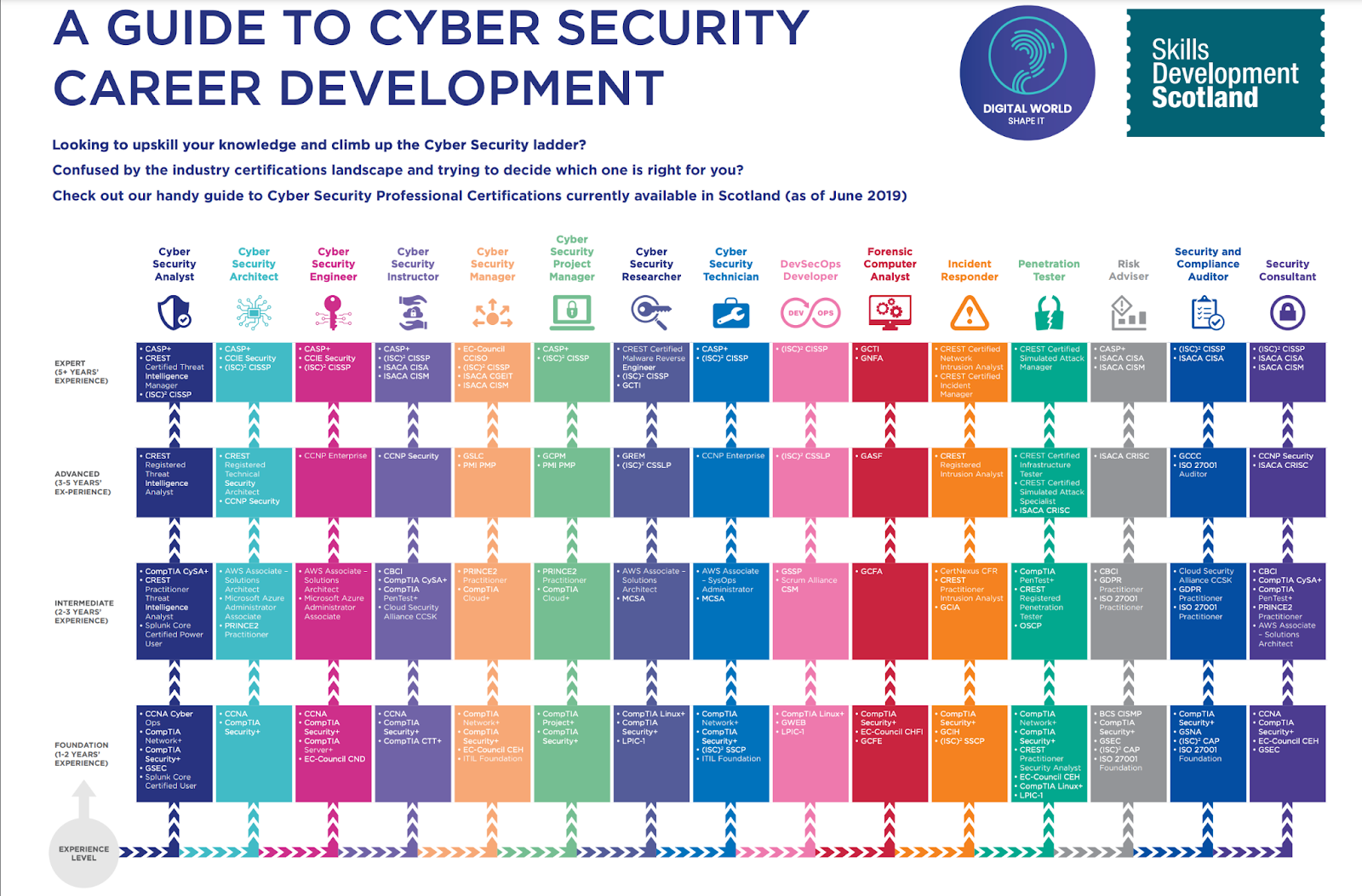
Certifications matter in this industry. They’re a quick way for a recruiter to confirm you’re not bluffing. But they’re not equal, and the order you stack them in matters.
| Certification | Level | Best for | Typical prerequisites |
|---|---|---|---|
| CompTIA Security+ | Entry | First cert, broad fundamentals | None (Network+ recommended) |
| Cisco CCNA | Entry | Networking foundation | None |
| (ISC)² CC (Certified in Cybersecurity) | Entry | Pure beginners, free for first 1M takers | None |
| EC-Council CEH | Mid | Ethical hacking, government roles | 2 years’ experience or training |
| Offensive Security OSCP | Mid–Senior | Serious pentesting credibility | Strong Linux and networking |
| (ISC)² CISSP | Senior | Management, architect, CISO track | 5 years’ experience |
| ISACA CISM | Senior | Security management and governance | 5 years’ experience |
If you’re starting from zero, the realistic stacking order is Security+ → CCNA or a vendor-specific cloud cert → CEH or OSCP, depending on whether you’re heading toward defensive or offensive work. CISSP comes later, once you’ve got the experience hours.
A realistic 6 to 12-month learning roadmap
This is the plan I’d give a younger sibling who came to me asking how to become a cybersecurity expert from scratch.
Months 1–2. Learn the fundamentals of networking and operating systems. Free resources work fine — Professor Messer’s Security+ videos on YouTube, the free tier of TryHackMe’s “Pre-Security” path, and the Linux Journey site.
Months 3–4. Earn CompTIA Security+. Budget around $400 for the exam voucher. Pair it with TryHackMe’s “SOC Level 1” path so you’ve got hands-on stories to tell, not just theory.
Months 5–6. Pick a specialisation lane — blue team (defensive) or red team (offensive). Start building a public GitHub portfolio of small projects, CTF write-ups, or home-lab documentation. Recruiters search GitHub. Make it easy for them to find you.
Months 7–9. Apply for entry-level cybersecurity jobs even if you don’t feel ready. SOC Analyst Tier 1, Junior IT Security Analyst, IT Helpdesk with a security angle. Volunteer projects for non-profits count as experience, too.
Months 10–12. Add a second certification aligned with your chosen lane. CCNA if you’re going defensive and want to grow toward architecture; the OSCP study path (PWK course) if you’re going offensive. Keep contributing publicly. Keep applying.
That timeline is realistic, not optimistic. Some people will move faster. Some, especially career-switchers with kids and a day job, will take eighteen months. Both are fine.
How AI is changing cybersecurity careers in 2026
You can’t write honestly about this field without mentioning AI. Generative AI has changed both sides of the fight. Attackers now use large language models to write more convincing phishing emails, generate polymorphic malware, and automate reconnaissance. Defenders use the same models to triage alerts, summarise incidents, and write detection rules.
What this means for someone starting is encouraging, not scary. Routine analyst work is getting automated, which sounds threatening until you notice the bottleneck has always been people, not tools. Companies don’t suddenly need fewer security professionals — they need ones who can work alongside AI systems, validate their output, and handle the cases AI gets wrong (which is most of the interesting ones).
If you’re learning the field in 2026, get comfortable using AI assistants the way a senior engineer uses a junior — give them the boring work, check their reasoning, never trust them blindly with anything that matters.
Cyber security salary: what can you actually earn?
Salaries vary wildly by country, role, and experience, so anyone who quotes you a single number is selling something. That said, here are honest 2025 reference points.
In the United States, the BLS reports a median annual wage for information security analysts of around $120,000, with experienced specialists in major metros earning well past $150,000. Recent industry estimates suggest top-of-market roles like principal security engineers at large tech companies can clear $300,000 in total compensation, and a CISO at a Fortune 500 company can earn $500,000 or more once equity is counted.
In the U.K., a junior SOC analyst typically starts between £30,000 and £40,000, with senior engineers and architects in London commanding £80,000 to £120,000. In India, entry-level cyber security analyst roles in cities like Bengaluru and Hyderabad commonly start between ₹5 and ₹9 lakh per year, climbing to ₹25 lakh and beyond for senior specialists at multinationals.
The pattern is consistent everywhere: experience matters more than credentials, specialisation pays better than generalism, and the people who can talk to executives without losing the technical thread earn the most.
Frequently asked questions about becoming a cybersecurity expert
Can I get into cybersecurity without a degree?
Yes. The fastest route is usually a help desk or junior IT role, plus a Security+ certification, plus a visible portfolio of self-directed learning on platforms like TryHackMe or Hack The Box. Many hiring managers in security care more about what you can demonstrate than where you studied.
How long does it take to become a cybersecurity expert?
“Expert” is fuzzy, but a focused beginner can be employable in an entry-level cybersecurity role in around 9 to 12 months. Reaching senior-level expertise usually takes another four to six years on the job. The learning never really stops — that’s part of why people stay in the field.
What is the highest-paying cybersecurity job?
At the very top, Chief Information Security Officers at large enterprises earn the most, often with total compensation packages above $500,000. Below the C-suite, the highest-paid technical roles are usually principal security engineers, application security leads at major tech companies, and independent senior penetration testers with specialised reputations.
Is cybersecurity hard to learn?
It’s challenging, but not in the way people fear. The hard part isn’t memorising tools — tools come and go. The hard part is building the underlying mental model of how systems talk to each other and where trust assumptions break down. Once that clicks, the field stops feeling like a maze and starts feeling like a language.
Which cybersecurity certification should I start with?
CompTIA Security+ is the standard first choice for most people. It’s vendor-neutral, widely recognised by employers, and the curriculum gives you a solid overview of the whole field. The newer (ISC ² Certified in Cybersecurity (CC) is also worth considering, especially because the first million candidates can sit for it for free.
Are cybersecurity jobs in demand in 2026?
Yes, dramatically. The (ISC ² workforce study and the BLS both project sustained shortages through the end of the decade. Recent industry estimates suggest the global gap remains in the millions, and demand is now broadening from large enterprises into mid-market businesses, healthcare providers, and public-sector agencies.
Ready to start your cybersecurity career?
Knowing how to become a cybersecurity expert is one thing — actually doing it starts with applying for the right first role. jobsRmine lists current openings across analyst, engineering, pentesting, and security leadership positions, from entry-level through senior. Browse cybersecurity jobs on jobsRmine and find the one that matches where you are right now, not where you wish you’d been three years ago. The field doesn’t care about your starting point. It cares whether you keep showing up.


