


Photo by Donald Teel on Unsplash
First job after college: 11 moves that work in 2026
Graduating used to feel like an ending. These days, it feels like the first day of a much harder job: finding one. The Class of 2025 is facing a 5.8% unemployment rate for 22- to 27-year-olds (Bureau of Labour Statistics), 41.8% underemployment, according to the Federal Reserve Bank of New York, and hiring rates that payroll provider Gusto says are 44% lower than those experienced by the Class of 2022. If you’re hunting for your first job after college, the search will probably take longer than your friends and family expect. Most of the moves that work are old. A few of the new ones are obvious once you see them.
Key takeaways
- Hiring for new graduates has declined sharply since 2022. Plan for 4 to 6 months, not 4 to 6 weeks.
- Internships convert. NACE puts the 2024-25 conversion rate at 63.1%, the highest in five years.
- Roughly one in five online job postings is a ghost job. Spot them before you spend your evening applying.
- Almost every Fortune 500 company runs your resume through an ATS first. Build for both the machine and the human.
- Referrals are 7% of applications and 40% of hires. Networking is the highest-ROI hour of your week.
What the 2025-2026 graduate job market actually looks like
The Class of 2025 walked into the toughest entry-level market in three years. Gusto’s data shows hiring for 20-24 year-olds peaked 44% below the 2022 high. The Class of 2026 might see a small rebound. NACE’s Job Outlook 2026 Spring Update has employers projecting 5.6% more new-grad hires.
Behind the headlines, the experience is uneven. Burning Glass Institute found that 52% of recent college graduates are working in jobs that don’t require a degree. ZipRecruiter’s 2026 grad survey reports 5% of the Class of 2025 were still searching a full year after walking the stage. Engineering grads averaged $78,731 starting salary (NACE), while the broader average sat around $68,000 (ZipRecruiter), versus the $100,000 most rising grads expected.
So if you’re feeling behind, you probably aren’t. The market is the market. The point is to play it well.
Get an internship, or build the closest substitute
If you have one chance to spend a semester on something that moves the needle, spend it on an internship. NACE’s 2026 Internship & Co-op Report puts the conversion rate from intern to full-time hire at 63.1% for the 2024-25 class, the highest in five years. The offer rate climbed nearly 10% year-over-year. Acceptance hit 88.3%.
Why it works: an internship is a 10-week interview, both ways. The employer sees you do the work. You see if you’d actually want to stay. Inside Higher Ed reported that recent grads who interned earn an average of $59,059 versus $44,048 for grads without one. That’s a $15,000 gap per year, compounding for a decade.
If a paid internship isn’t realistic, build proof of work some other way. Contribute to an open-source project. Run a small consulting gig over the summer. Write three real case studies of work you’ve done.
Network with intent, and skip the panic version.
The “85% of jobs are filled through networking” line gets repeated everywhere. It’s based on a single non-random LinkedIn survey from 2016. Treat it sceptically.
The cleaner stat: at most large employers, referrals make up about 7% of applications and roughly 40% of hires. That’s the gap you’re optimising for. A referral bypasses most of the ATS scoring and lands your resume on a recruiter’s desk with a human vouching for you.
What this looks like for a recent grad:
- Email five alumni from your school who work in roles you’d want. One at a time. Ask for 20 minutes, not for a job.
- Pick two professors who actually know you. Tell them what you’re looking for and ask if anyone in their network might be open to a conversation.
- Show up at one industry event a month. Just to learn one thing and meet one person.
The high-volume approach (mass-applying on LinkedIn) feels productive. The data says it isn’t.
Build a resume that survives AI screeners.
Jobscan’s 2025 review of every Fortune 500 company found that 97.8% of them run an applicant tracking system. The dominant platforms (Workday, Greenhouse, Lever, iCIMS) handle most of the volume. Your resume probably gets parsed by software before any human sees it.
A few things worth knowing. The widely-cited “75% of resumes are auto-rejected by ATS” claim is shakier than it looks; the trail leads back to a vendor (Preptel) that shut down in 2013. Most modern ATS platforms rank and sort rather than reject outright. What does matter is keyword match. A 2026 ResumeAdapter analysis found 52% of the keywords in a typical job description are missing from the average applicant’s resume, even when the applicant is qualified.
Formatting matters less than it used to, with two exceptions. Heavy graphics and multi-column layouts still trip up some parsers. Stick to a clean, single-column, text-based resume saved as .docx or .pdf.
Practical version: open the job description, list every noun and verb that describes the work, then check your resume against that list. If you can’t honestly include a keyword, leave it out. Fabricating skills to beat the ATS just buys you a worse rejection later. I
Image: a recent graduate’s resume on a laptop screen with highlighted keywords matching a job description. Alt: New graduate optimising a resume for an applicant tracking system keyword matching.
Spot ghost jobs before they waste your week
Greenhouse’s 2025 analysis estimates 18 to 22% of online job postings are ghost jobs (positions employers don’t actually plan to fill). A LiveCareer survey of 918 HR professionals in March 2025 reported that 45% post ghost jobs “regularly” and another 48% post them “occasionally”. MyPerfectResume’s June 2025 analysis of BLS JOLTS data found 30% of US job openings that month never resulted in a hire.
Why they exist: building a talent pipeline, projecting growth, satisfying internal posting requirements, and keeping current employees feeling replaceable. None of those reasons helps you.
How to spot one:
- The same listing has been live for more than 30 days at a mid-sized or larger company.
- The role gets reposted on the same date every two weeks with no real edits.
- The “entry-level” job lists 3 to 5 years of required experience.
- The hiring contact’s LinkedIn says they left the company six months ago.
- The recruiter never replies to a polite follow-up note after two weeks.
A 30-second check of the company’s careers page (does the role still appear? When was it first posted?) saves you the hour of writing a tailored application.
Apply where the demand actually is
The frozen-market story is real, but it isn’t uniform. BLS reports 22-27 year-olds at 5.8% unemployment overall, but the breakdown by field tells a much more useful story:
- Nursing graduates face a 1.4% unemployment rate (Federal Reserve Bank of New York analysis).
- Skilled trades (electrical, HVAC, plumbing) have over 400,000 unfilled construction openings most months, per BLS data.
- Healthcare, education, and certain technical fields are still hiring strongly.
- Tech is bifurcated. Senior roles stay competitive while junior software work gets squeezed by both layoffs and AI tooling.
Geography helps too. Mid-sized employers in second-tier metros generally see fewer applicants per role than the same-sized company in NYC or San Francisco. The same resume converts better in Columbus or Raleigh than in Manhattan.
Tailor every application, even when it’s painful.
Mass applications maximise effort and minimise return. Recruiters spend an average of about 7.4 seconds on a first resume scan, per Ladders’ eye-tracking research. If your first ten lines don’t match the job, you don’t make it past that scan.
Tailoring means rewriting the top third of your resume and the first line of your cover letter for each application. That’s the part the ATS scores hardest, and the recruiter sees first. The bottom two-thirds can stay roughly the same.
Send eight tailored applications a week, and you’ll convert better than someone sending fifty generic ones. The math works in your favour.

Prep interviews like a human, not a script
The biggest interview mistake for new grads is over-rehearsing. Memorised answers come out flat. They also collapse the second the interviewer asks a follow-up question.
What works better: pick six to eight stories from your last four years. Internships, projects, group work, side hustles. One story per “competency” the role cares about (collaboration, problem-solving, technical depth, leadership). Practice telling each story out loud, in conversation, in 90 seconds. Know the result of each one: a number, a shipped artefact, a decision the team made because of your work.
For the company side, read the last two quarterly updates if it’s public, the last three pieces of press coverage, and the LinkedIn profile of whoever’s interviewing you. Twenty minutes of prep is enough.

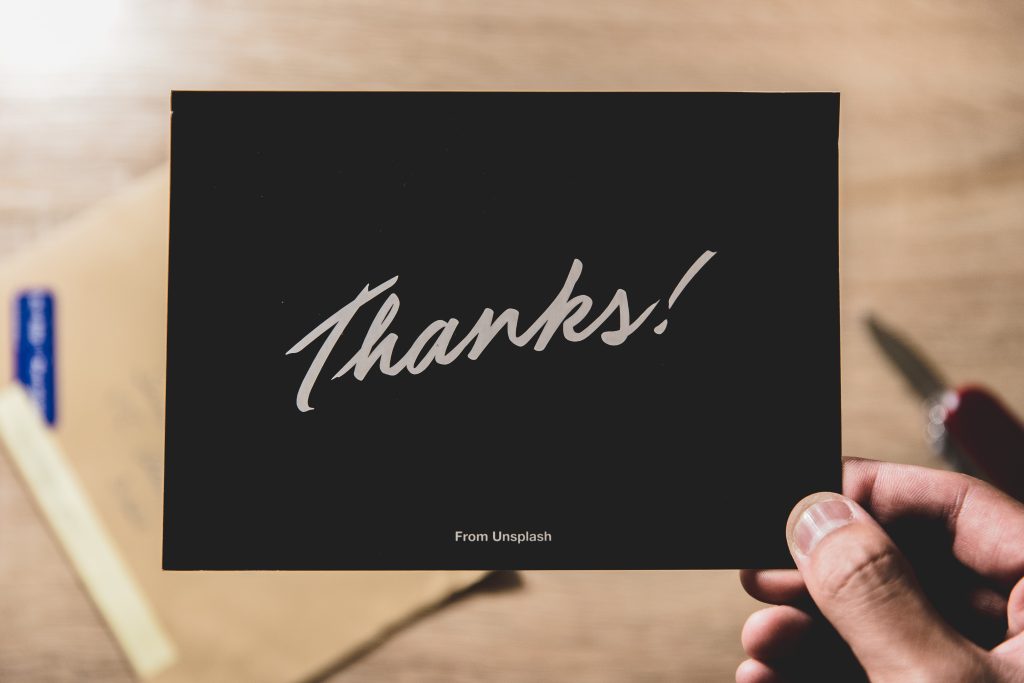
Send the handwritten thank-you note.
A CareerBuilder survey of US hiring managers found that 88% remembered candidates who sent handwritten thank-you notes more vividly than candidates who didn’t, and 62% said they’d remember a handwritten note for at least a year. The number of emails was a fraction of that.
The reason it still works is simple. Barely anyone does it anymore. A short note on real stationery costs you 8 minutes and a postage stamp, and it lands on the interviewer’s desk a few days after the interview, exactly when they’re making the decision.
Image: a handwritten thank-you card resting next to a laptop displaying a job application. Alt: A recent graduate’s handwritten thank-you note placed beside a laptop after a job interview.
Start before you graduate.
Most of what works is just earlier execution. Eight out of ten students in NACE’s 2025 Student Survey expected to start work within three months of graduating. In reality, only 77% did, per ZipRecruiter’s 2026 grad report. The gap is mostly about timing.
If you’re a junior or rising senior reading this, the moves are simple. Build your LinkedIn profile this month. Get your first internship before next summer. Attend your on-campus career fair; ZipRecruiter found 1 in 5 recent grads reported it produced a meaningful connection or interview. Start emailing alumni 12 months before graduation, not two weeks after.
If you’ve already graduated and you’re still looking, the same advice applies. The earliest you can start is today.
Pick one application at a time, not fifty.
When the search drags on, the instinct is to apply more. The better instinct is to apply better. Multiple applications mean tracking, follow-ups, custom prep, and the cognitive load of remembering which version of your story you sent to which company. It eats your days.
Run two or three serious applications a week with real research, tailored documents, and a referral attempt where possible. Block the rest of the week for skill-building, portfolio work, and networking. You’ll convert at a much higher rate.
Treat your first job after college as a launchpad.
Your first job after college matters less than people tell you. Almost everyone changes roles within 18 to 36 months. What the first job does is set a baseline: it teaches you how a workplace runs, what you’re actually good at, and what your “next” looks like.
Take an offer that’s 80% right if the alternative is six more months of searching. Spend year one learning the actual work and building a reputation. The bigger optionality compounds in years two and three.
Frequently asked questions
How long does it take to find your first job after college?
The Bureau of Labour Statistics puts the average job search at about 20.6 weeks, just under five months. For new grads specifically, three to six months is a realistic window in the 2025-2026 market. If you’re still searching at month seven without serious interviews, the problem is usually your resume, your targeting, or your network, rather than the market.
What should I do if I can’t find a job after 6 months?
Treat it as a diagnostic. Get a second pair of eyes on your resume from your career centre. Audit which roles you’re applying to; they’re probably too senior, or too generic. Pivot to a part-time, contract, or freelance role that builds proof of work while you keep searching. Six months of imperfect work beats six months of nothing on your resume.
Should I take any job or hold out for the right one?
If a role is 80% close to what you want and your alternative is more months of searching, take it. You’ll learn faster on the job than on LinkedIn. If a role has no connection to anything you want long-term, take it only if your runway demands it. Your first job sets the baseline you’ll build from.
When is the best time to start applying for jobs as a senior?
August to October of senior year for fall recruiting; most large-company programs hire then. January to March for spring cycles. Government and healthcare roles often hire later. If you’re outside structured campus recruiting, six months before graduation is the right starting line.
The bottom line
The market for your first job after college is harder than it was three years ago, and probably harder than your parents are admitting. The moves that work are unglamorous. Internships. Real networking. Tailored applications. Decent interview prep. A handwritten note. Some patience.
Pick three moves from above and start them this week. The compounding starts when you do the slower, less satisfying work that actually moves the needle.


